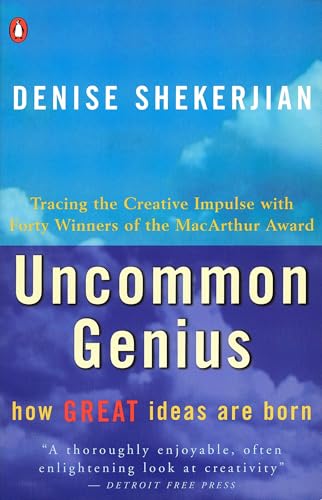
Uncommon Genius: How Great Ideas are Born
📄 Viewing lite version
Full site ›
13.76
USD
🛒 Buy New on Amazon 🇺🇸
Book Details
Author(s)Denise Shekerjian,
PublisherPenguin Books
ISBN / ASIN0140109862
ISBN-139780140109863
Sales Rank251,196
CategoryPsychology
MarketplaceUnited States 🇺🇸
Description ▲
At the age of 38, John D. MacArthur, a destitute high-school dropout, borrowed $2,500 to buy the Bankers Life & Casualty Company of Chicago; eight years later he'd made a million dollars. At the time of his death in 1978 he was the second-richest man in America and "notoriously tightfisted." But he left most of his two-and-a-half-billion-dollar estate in the form of the John D. and Catherine T. MacArthur Foundation, with only these instructions to his board of trustees: "I figured out how to make the money, you boys figure out how to spend it." Thus the MacArthur Prize, also known as the "genius grant," was born. The award cannot be applied for, and it is not limited to any particular field of interest. Its purpose "is to promote those leaps of creative thinking that may occur when gifted people are left to their own devices." For Uncommon Genius, Shekerjian interviewed forty MacArthur Prize winners--John Sayles, Peter Sellars, Ellen Stewart, and Derek Walcott among them--in an attempt to discover "how great ideas are born." While much of what she learns about the creative impulse is not exactly groundbreaking--it involves risk-taking, openness, concentration, resiliency, and a great love of the work--spending time with the creators she has chosen to include is fascinating. They bring these broad concepts to life by inviting us into their studios, offices, labs, even dorm rooms (the youngest interviewee, Mayan epigraphist David Stuart, was a Princeton student at the time) and discussing their own creative processes. There is much to be gleaned here, not only about how creativity applies itself to various fields (community action, political science, writing, art history, woodworking, and even being a clown), but about how to nurture your own "creative genius." --Jane Steinberg
More Books in Psychology
Cognitive Neuropsychology: A Clinical Introduction
View
Kassin Social Psychology Seventh Edition Plus Lahiri T…
View
Attention Deficit Hyperactivity Disorder (adhd) Resear…
View
Enhancing Sexuality: A Problem-Solving Approach Client…
View
The Psychology Research Handbook: A Guide for Graduate…
View
Carl Jung and Soul Psychology
View
Anthropology and Psychoanalysis: An Encounter Through …
View
Invisible Acts of Power: Channeling Grace in Your Ever…
View
From Ancient Myth to Modern Healing: Themis: Goddess o…
View