Why do Republican politicians promise to rein in government, only to face repeated rebellions from Republican voters and media critics for betraying their principles? Why do Democratic politicians propose an array of different policies to match the diversity of their supporters, only to become mired in stark demographic divisions over issue priorities? In short, why do the two parties act so differently-whether in the electorate, on the campaign trail, or in public office?
Asymmetric Politics offers a comprehensive explanation: The Republican Party is the vehicle of an ideological movement while the Democratic Party is a coalition of social groups. Republican leaders prize conservatism and attract support by pledging loyalty to broad values. Democratic leaders instead seek concrete government action, appealing to voters' group identities and interests by endorsing specific policies.
This fresh and comprehensive investigation reveals how Democrats and Republicans think differently about politics, rely on distinct sources of information, argue past one another, and pursue divergent goals in government. It provides a rigorous new understanding of contemporary polarization and governing dysfunction while demonstrating how longstanding features of American politics and public policy reflect our asymmetric party system.
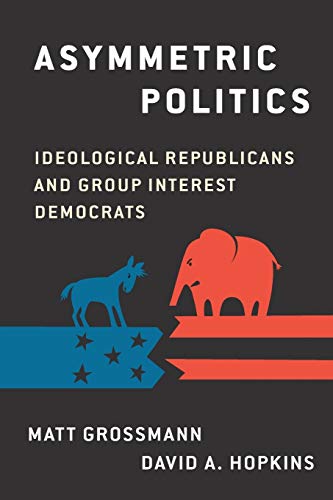
Asymmetric Politics: Ideological Republicans and Group Interest Democrats
📄 Viewing lite version
Full site ›
31.75
47.99 USD
🛒 Buy New on Amazon 🇺🇸
🏷 Buy Used — $16.03
✓ Only 13 left in stock (more on the way).
Book Details
Author(s)Grossmann, Matt
PublisherOxford University Press, USA
ISBN / ASIN0190626607
ISBN-139780190626600
AvailabilityOnly 13 left in stock (more on the way).
Sales Rank1,138
CategoryPaperback
MarketplaceUnited States 🇺🇸
Description ▲
Similar Products ▼
- Uncivil Agreement: How Politics Became Our Identity
- Insecure Majorities: Congress and the Perpetual Campaign
- Identity Crisis: The 2016 Presidential Campaign and the Battle for the Meaning of America
- The Politics of Resentment: Rural Consciousness in Wisconsin and the Rise of Scott Walker (Chicago Studies in American Politics)
- Democracy for Realists: Why Elections Do Not Produce Responsive Government (Princeton Studies in Political Behavior)
- The Inevitable Party: Why Attempts to Kill the Party System Fail and How they Weaken Democracy
- The Great Alignment: Race, Party Transformation, and the Rise of Donald Trump
- Why Parties?: A Second Look (Chicago Studies in American Politics)
- The Party Decides: Presidential Nominations Before and After Reform (Chicago Studies in American Politics)
- Neither Liberal nor Conservative: Ideological Innocence in the American Public (Chicago Studies in American Politics)
More Books in Paperback
Nightmare Hour TV Tie-in Edition
View
First Light
View
The Miles Between
View
Prize Stories 1990: The O. Henry Awards (Pen / O. Henr…
View
Democracy Begins Between Two
View
The Model Locomotive Engineer, Fireman, and Engine Boy
View
Bloodline in the Sand
View
Making America, Volume A, Brief, 2nd Ed + Perfect Unio…
View
Ellis, Becoming a Master Student, 11th Edition Plus My…
View