Search Books
Can Green Sustain Growth?: … Simple Habits for Complex T…

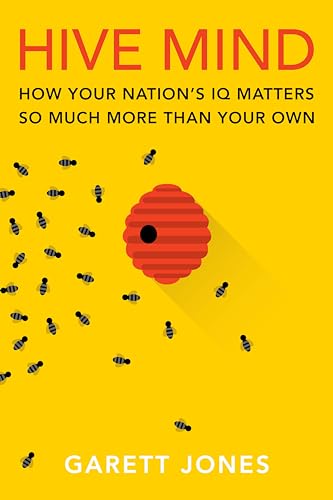
Hive Mind: How Your Nation’s IQ Matters So Much More Than Your Own

Author Jones, Garett
Publisher Stanford Economics and Finance
Category Business & Economics
📄 Viewing lite version Full site ›
🌎 Shop on Amazon — choose country
21.26 25.00 USD
🛒 Buy New on Amazon 🇺🇸

✓ In Stock.

Share:
Book Details
Author(s)Jones, Garett
ISBN / ASIN0804785961
ISBN-139780804785969
AvailabilityIn Stock.
Sales Rank840,154
MarketplaceUnited States 🇺🇸

Description

Over the last few decades, economists and psychologists have quietly documented the many ways in which a person's IQ matters. But, research suggests that a nation's IQ matters so much more.

As Garett Jones argues in Hive Mind, modest differences in national IQ can explain most cross-country inequalities. Whereas IQ scores do a moderately good job of predicting individual wages, information processing power, and brain size, a country's average score is a much stronger bellwether of its overall prosperity.

Drawing on an expansive array of research from psychology, economics, management, and political science, Jones argues that intelligence and cognitive skill are significantly more important on a national level than on an individual one because they have "positive spillovers." On average, people who do better on standardized tests are more patient, more cooperative, and have better memories. As a result, these qualities and others necessary to take on the complexity of a modern economy become more prevalent in a society as national test scores rise. What's more, when we are surrounded by slightly more patient, informed, and cooperative neighbors we take on these qualities a bit more ourselves. In other words, the worker bees in every nation create a "hive mind" with a power all its own. Once the hive is established, each individual has only a tiny impact on his or her own life.

Jones makes the case that, through better nutrition and schooling, we can raise IQ, thereby fostering higher savings rates, more productive teams, and more effective bureaucracies. After demonstrating how test scores that matter little for individuals can mean a world of difference for nations, the book leaves readers with policy-oriented conclusions and hopeful speculation: Whether we lift up the bottom through changing the nature of work, institutional improvements, or freer immigration, it is possible that this period of massive global inequality will be a short season by the standards of human history if we raise our global IQ.

The Power of Habit: Why We Do What We Do in Life and B…
View
Understanding and Managing Sales and Use Tax (Seventh …
View
Business Etiquette For Dummies
View
Business Development for the Biotechnology and Pharmac…
View
Sidetracked Home Executives(TM): From Pigpen to Paradi…
View
The Neatest Little Guide to Stock Market Investing: Fi…
View
Effective Grant Writing and Program Evaluation for Hum…
View
Engineering Ethics: An Industrial Perspective
View