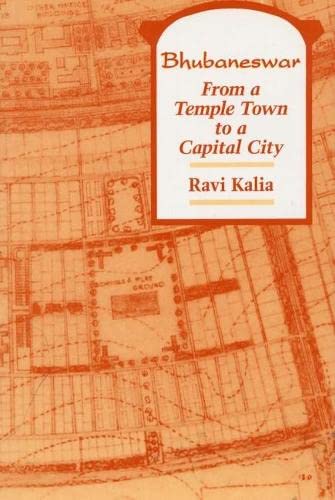
When Orissa was constituted as the eleventh province of British India in 1936, the need for a new capital was immediately evident. In explaining the political, economic, and religious reasons for constructing the new capital of the region at Bhubaneswar, Ravi Kalia notes the often conservative attitudes of the Oriyan people, who initially opposed the transformation of this revered site into a capital city. Before it became the capital of Orissa in 1948, Bhubaneswar had been a temple town and an important Hindu cultural and religious center to followers of Buddhism, Jainism, Shaivism, and Vaishnavism. The presence of so many different religions in fact gave the city its pluralistic character, one of the factors responsible for its eventual selection as the capital city.
The German planner Otto Koenigsberger was hired to implement the design of the new capital city. As Kalia explains, Koenigsberger and the Oriyas disagreed broadly in concept, with Koenigsberger perceiving the development of New Bhubaneswar along secular lines. He saw a flourishing city with political autonomy, organized commercial relationships, and brave new architecture that could accommodate the requirements of modern life. In contrast, the Oriyas wanted the city to retain its close relationship to its religious past. As a result, the conflicting concepts of temple town and capital city struggled for dominance.
In the end, even though Koenigsberger provided a master plan, the developments in Bhubaneswar were carried out by British-trained Indians eager to find their own identity. The final shape and style of Bhubaneswar, Kalia concludes, bear the imprint of Indian religion as much as that of Western rationalism.