Search Books
U.S. Master Bank Tax Guide …

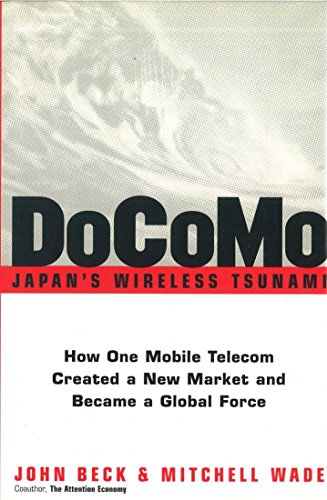
DoCoMo--Japan's Wireless Tsunami: How One Mobile Telecom Created a New Market and Became a Global Force

Author John Beck, Mitchell Wade
Publisher AMACOM
Category Business & Economics
📄 Viewing lite version Full site ›
🌎 Shop on Amazon — choose country
3.99 25.00 USD
🛒 Buy New on Amazon 🇺🇸 🏷 Buy Used — $1.99

✓ Usually ships in 1-2 business days

Share:
Book Details
PublisherAMACOM
ISBN / ASIN0814407536
ISBN-139780814407530
AvailabilityUsually ships in 1-2 business days
Sales Rank5,041,666
MarketplaceUnited States 🇺🇸

Description

America is just waking up to the vast potential of the wireless Web. In Japan, nearly a third of the population already works, plays, and shops with wireless, continuously connected to a universe of data, services, and communities. The force responsible is a young company with a name that means "anywhere" in Japanese: DoCoMo. Another case study that examines a specific corporation for management lessons it can share with others, DoCoMo--Japan's Wireless Tsunami takes a riveting look at the world’s second-largest mobile phone service that has, after only two years, a customer base as big as AOL’s. Don’t think of this book as an apology for the languishing telecom industry. Instead, it’s an inside look at how creativity and innovation were nurtured at one of the world’s stodgiest companies--Nippon Telephone and Telegraph--and how a small team of committed visionaries never said "Never" and created DoCoMo’s extraordinarily popular I-mode technology.

For those who've read of the importance of "intrapreneurship" in corporations, here is a real-life exploration of that principle in action. Noted business strategists John Beck (The Attention Economy) and Mitchell Wade give us story upon story of the dynamic personalities behind I-mode, from NTT Chairman Kouji Ohboshi--who saw DoCoMo through a series of crises that would have meant early death for most U.S. startups--to CEO Keiji Tachikawa, whose post-WWII childhood gave him a keen grasp of the economics of disparity.

With chapter headings like "People-People Who Need People" and "Passion Is Destiny," this book sends the strong message that every successful business model depends so heavily on the human factor--a point that seems lost in the venture-capital-dominated model of the West. With lessons for all business leaders, in any industry, this book stands as a testament to the pivotal role of conviction, integrity, and personal passion in business success. --Charles Decker

Business Cycles and Forecasting
View
Development Economics: Its Position in the Present Sta…
View
Cost Systems Design
View
So You Want to Dance on Broadway
View
The Blueprint: Reviving Innovation, Rediscovering Risk…
View
Managing IT Outsourcing, Second Edition
View
Education and the Creation of Capital in the Early Ame…
View
Global Corruption Report 2005: Special Focus: Corrupti…
View
More Tales for Trainers: Using Stories and Metaphors t…
View