Drawing on wills and dowries, judicial cases, town council records, and royal decrees, Mangan brings alive the bustle of trade in Potosí. She examines quotidian economic transactions in light of social custom, ethnicity, and gender, illuminating negotiations over vendor locations, kinship ties that sustained urban trade through the course of silver booms and busts, and credit practices that developed to mitigate the pressures of the market economy. Mangan argues that trade exchanges functioned as sites to negotiate identities within this colonial multiethnic society. Throughout the study, she demonstrates how women and indigenous peoples played essential roles in Potosí’s economy through the commercial transactions she describes so vividly.
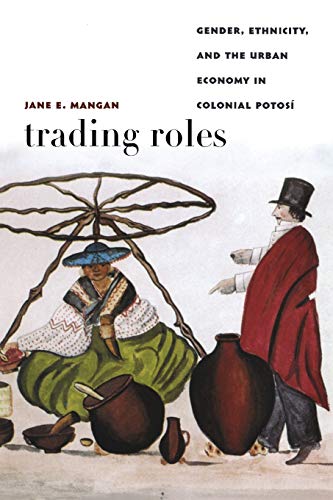
Trading Roles: Gender, Ethnicity, and the Urban Economy in Colonial Potosà (Latin America Otherwise)
📄 Viewing lite version
Full site ›
Book Details
Author(s)Mangan, Jane E.
PublisherDuke University Press Books
ISBN / ASIN0822334704
ISBN-139780822334705
AvailabilityIn Stock.
Sales Rank1,139,307
CategoryBusiness & Economics
MarketplaceUnited States 🇺🇸
Description ▲
Located in the heart of the Andes, Potosí was arguably the most important urban center in the Western Hemisphere during the colonial era. It was internationally famous for its abundant silver mines and regionally infamous for its labor draft. Set in this context of opulence and oppression associated with the silver trade, Trading Roles emphasizes daily life in the city’s streets, markets, and taverns. As Jane E. Mangan shows, food and drink transactions emerged as the most common site of interaction for Potosinos of different ethnic and class backgrounds. Within two decades of Potosí’s founding in the 1540s, the majority of the city’s inhabitants no longer produced food or alcohol for themselves; they purchased these items. Mangan presents a vibrant social history of colonial Potosí through an investigation of everyday commerce during the city’s economic heyday, between the discovery of silver in 1545 and the waning of production in the late seventeenth century.
More Books in Business & Economics
Business Cycles and Forecasting
View
Development Economics: Its Position in the Present Sta…
View
Cost Systems Design
View
So You Want to Dance on Broadway
View
The Blueprint: Reviving Innovation, Rediscovering Risk…
View
Managing IT Outsourcing, Second Edition
View
Education and the Creation of Capital in the Early Ame…
View
Global Corruption Report 2005: Special Focus: Corrupti…
View
More Tales for Trainers: Using Stories and Metaphors t…
View